
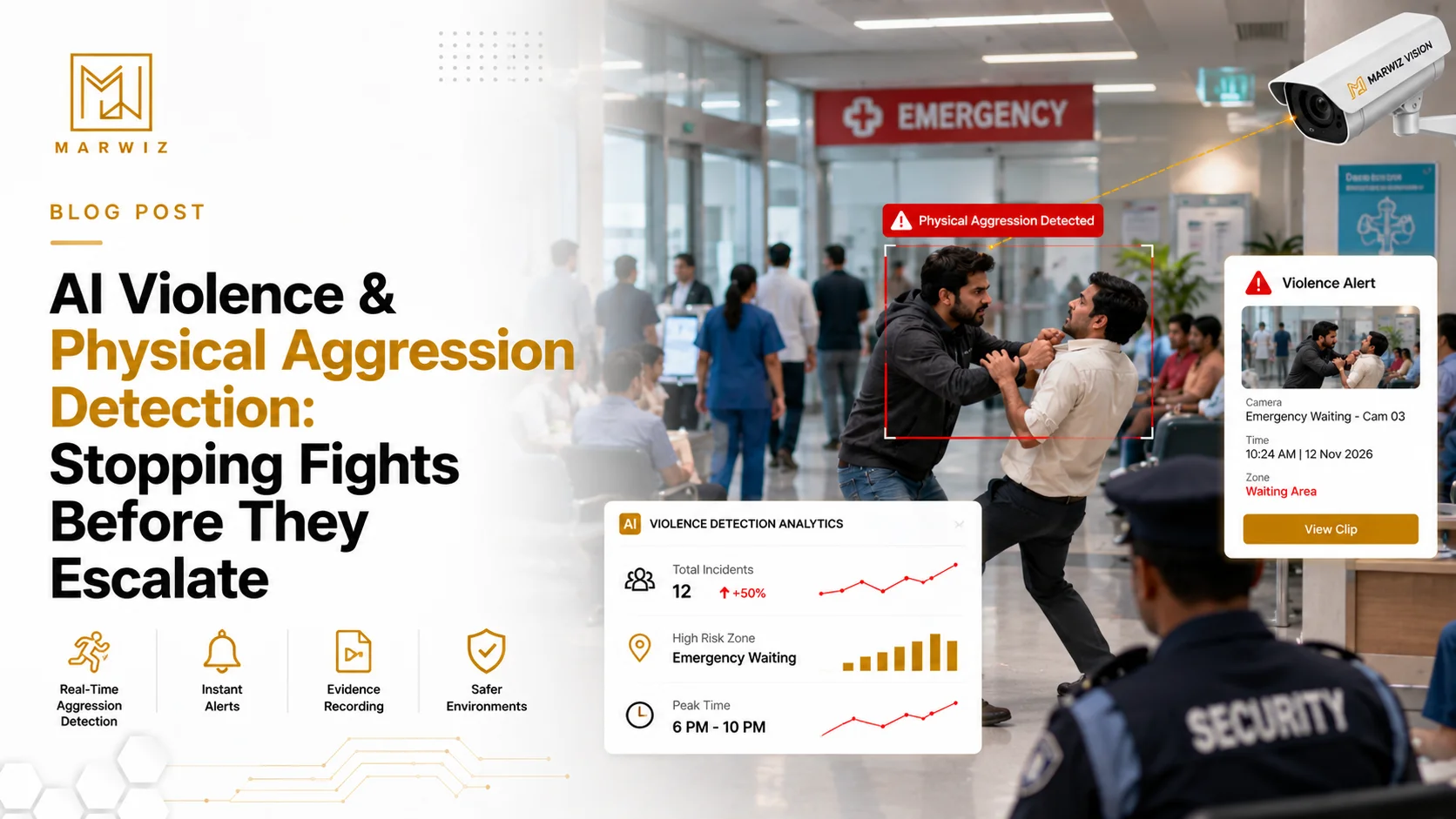
Most fights do not begin as fights. They begin as an argument at a billing counter, a crowd pressing against an emergency-room door, or two people squaring up in a parking lot. Security usually arrives after the first punch, when a scuffle has already become an injury, a police case, or a viral video. AI violence detection aims to shorten that gap by flagging physical aggression in its first seconds.
How Big Is the Problem in India?
Healthcare offers the clearest data, because researchers have measured it repeatedly.
- Studies have found that in India up to 75% of doctors have experienced some form of violence in the workplace.
- A 2026 paper in the National Medical Journal of India says more than 75% of doctors have witnessed some form of workplace violence.
- A survey of 601 healthcare workers in North India found that about three-quarters (76.04%) had experienced violence in healthcare settings. Most respondents came from government hospitals.
- A recent nationwide survey of 1,566 healthcare workers by experts from VMMC, Safdarjung Hospital, and AIIMS found that 58.2% felt unsafe at work, and 78.4% said they had faced threats.
- One summary of earlier Indian surveys reports that 62% of doctors said they could not see patients without fear of violence, and 57% had considered hiring security staff.
Researchers point to overcrowding, long waiting hours, understaffing, and inadequate security as drivers of patient frustration and aggression. The same pattern applies beyond hospitals. Bank branches, retail stores, schools, hostels, factory gates, and event venues all have queues, crowds, and tempers. Healthcare workers also tend to under-report incidents, so the true count is probably higher.
Why Security Teams Miss the Early Moments
- Speed: An argument can turn physical in seconds. A guard watching 30 screens will not catch it.
- Distance: The guard is often at the main gate while the confrontation is in a corridor or parking level.
- Attention limits: Continuous screen monitoring loses effectiveness quickly, and the trigger moment is brief.
- No record: Without footage tagged to the exact moment, incident reports rely on conflicting accounts.
- Under-reporting: People often hesitate to report, as the healthcare studies note, so management never sees the full pattern.
How AI Violence Detection Works
The system analyzes live video from your existing IP cameras and looks for patterns in body movement, not faces or identities.
- People tracking: The AI detects and tracks each person in the frame.
- Movement analysis: It looks at posture and motion, such as rapid arm swings, striking or pushing motions, grappling, a person on the ground with others around them, or a sudden crowd converging on one spot.
- Scoring: The model rates how strongly the activity matches aggression versus normal movement, and a threshold you set decides when an alert fires.
- Alert: Security receives a notification with the camera, location, time, and a clip of the moment.
- Human confirmation: An operator reviews the clip, decides whether it is real, and dispatches staff.
- Logging: The event is stored for reports and follow-up.
What "Before They Escalate" Really Means
It is worth being precise, because this is where vendors overclaim. AI does not read minds and cannot predict who will start a fight. What it can do is detect early physical signs, such as shoving, raised arms, or a group closing in on one person, and alert staff quickly. That still buys valuable time. A guard alerted at the first push has a very different situation to handle than one who arrives after a beating.
Manual Monitoring vs. AI Violence Detection
| Factor | Guards + Standard CCTV | AI Violence Detection |
|---|---|---|
| Detection time | After someone notices, often after injury | Seconds after aggressive movement begins |
| Coverage | Limited by the number of screens watched | Every connected camera, 24x7 |
| Location accuracy | "Somewhere near the ward" | Exact camera and zone |
| Evidence | Hard to reconstruct | Timestamped clip of the event |
| Pattern visibility | Rare | Hotspots by area, time, and shift |
| Consistency | Varies with staffing and fatigue | Same rules on every camera |
Where This Detection Helps Most
- Hospitals and clinics: Emergency departments, casualty, OPD waiting areas, and ICU corridors are known flashpoints. Detection alerts security while staff are still trying to de-escalate, and the footage supports the incident report and any legal action.
- Banks and ATMs: Disputes at counters, harassment near ATMs, and altercations in queues can be flagged early, and clips support any police complaint.
- Schools, colleges, and hostels: Physical bullying and fights in corridors, playgrounds, and hostel areas often occur out of a teacher's sight.
- Retail, malls, and hospitality: Crowded entrances, food courts, parking areas, and event venues generate altercations, especially late at night.
- Factories, warehouses, and gates: Disputes between workers or with visitors at gates can escalate quickly, and a fast alert protects both staff and equipment.
- Transit hubs and public spaces: Crowd surges and brawls need rapid response because of the numbers involved.
Limits You Should Know About
Being open about limitations builds trust with technical buyers.
- False alerts: Play-fighting, sports, dancing, hugging, or a person helping someone up can look like aggression to a model. This is why human confirmation matters.
- Camera dependence: Poor lighting, occlusion, low resolution, and awkward angles reduce accuracy.
- Not every act is visible: Verbal abuse, threats, and violence outside camera view will not be detected.
- It supports, not replaces, people: The system alerts. Trained staff still have to respond, de-escalate, and follow protocol.
What to Check Before You Deploy
| Check | What to Ask Your Vendor |
|---|---|
| Real-world accuracy | What are the false-alert rates on sites like yours, not just lab data? Run a pilot on your cameras. |
| Human verification | Does every alert go to an operator for confirmation before dispatch? |
| Sensitivity control | Can you tune thresholds by zone, such as stricter in an ER and looser at a sports ground? |
| Alert path | Who receives the alert, how quickly, and on which device? |
| Response protocol | Do you have a written escalation plan so staff know what to do when an alert arrives? |
| Privacy and retention | Is analysis based on movement, not identity? How long are clips stored, who can see them, and how does this fit the Digital Personal Data Protection Act, 2023? |
| Camera coverage | Are blind spots such as stairwells, parking, and corridors covered? |
| Reporting | Can you see hotspots by location and time to plan staffing and layout? |
Pair Detection with the Root Causes
Researchers link hospital violence to overcrowding, long waits, understaffing, and inadequate security. Detection helps with the last item, and its data helps with the others. If reports show that most incidents occur near the billing counter at 6 pm, that is a staffing and process problem you can fix. Used this way, the system does more than alert. It shows where the environment produces conflict.
From Reaction to Early Response
Security cannot be everywhere, and it cannot watch every screen. What it can do is respond quickly when something goes wrong, and AI detection gives it the alert it needs. For hospitals and other high-footfall sites, that can mean a minor confrontation stays minor.
Marwiz Vision runs behavior detection on the same platform as restricted-area monitoring, loitering and intrusion detection, and reporting. A violence alert, its clip, and its record then sit alongside every other security event in one dashboard.