
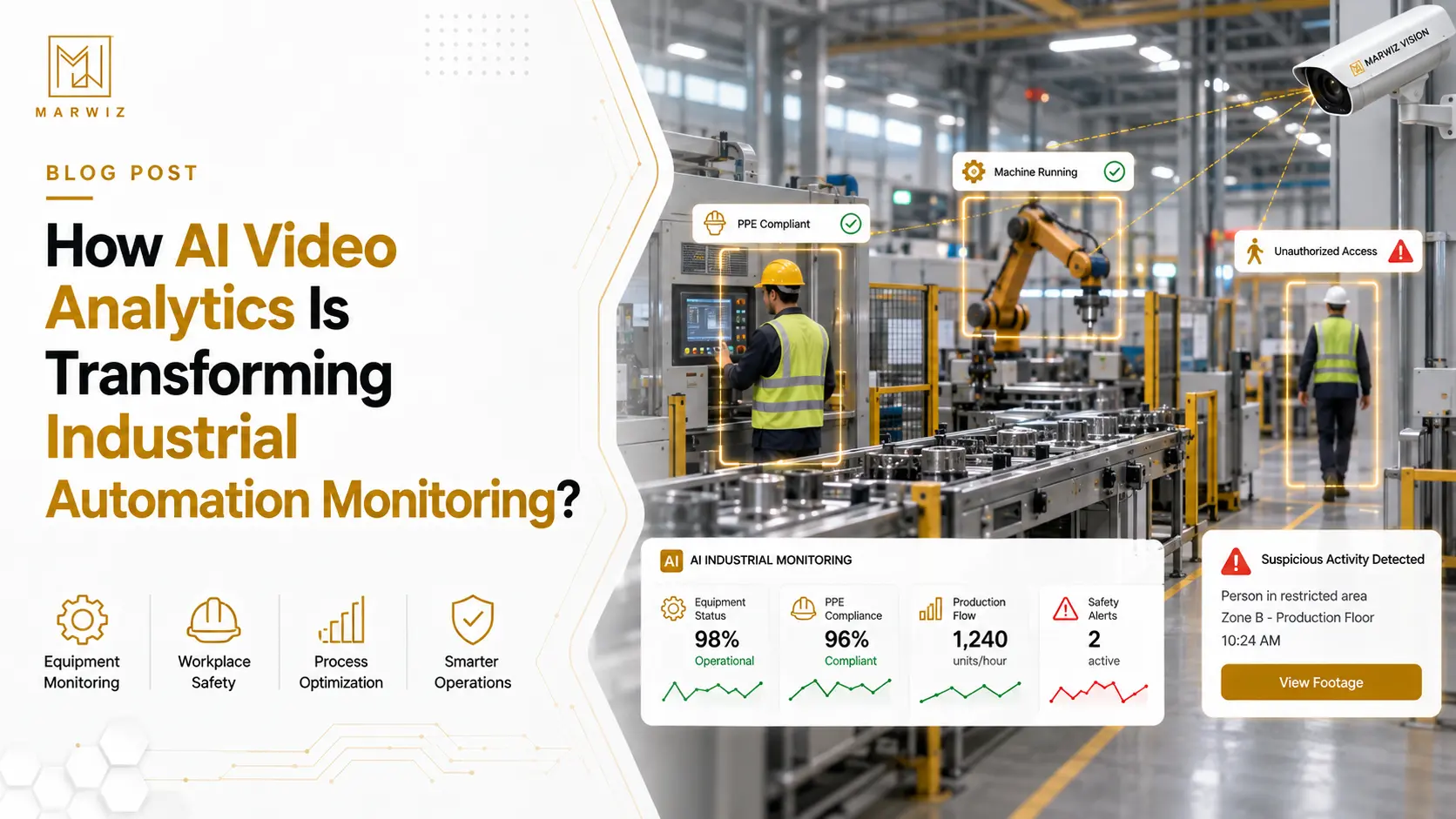
Factories produce amounts of operational data every day but old monitoring still depends on people watching, separate sensors and waiting to react.
AI video analytics changes AI video analytics by turning cameras into smart monitoring tools. Giving real-time view, automatic alerts and insight from data.
This is fast becoming central to industrial automation monitoring across Industry 4.0 environments.
What Is Industrial Automation Monitoring?
Industrial automation monitoring means watching production environments as they happen. Keeping track of machine conditions, how processes move and whether workers are safe. When factories grow bigger it's hard to stay on top of everything by hand. That’s why manufacturers are turning to monitoring systems. These tools give views of what’s going on and use automatic analysis to spot problems fast.
What Is AI Video Analytics?
AI video analytics uses computer vision, machine learning and deep learning with video feeds. It looks for objects, checks behavior, finds patterns and spots events. It is different from CCTV. It does not record. It understands what it sees. It creates information from normal security cameras.
From Traditional to AI Industrial Monitoring
Traditional monitoring relies on manual observation, limited visibility, reactive response, and delayed issue detection.
AI industrial monitoring offers automated detection, real-time alerts, continuous coverage, and data-driven, predictive insight - which is why adoption is accelerating across manufacturing.
How AI Video Analytics Works?
- Video capture - industrial cameras record production and equipment activity.
- AI processing - computer vision algorithms analyse the visual data.
- Pattern recognition - the system identifies objects, movements, and events.
- Real-time alerts - potential issues are flagged automatically.
- Data insights - the platform surfaces operational intelligence over time.
Key Ways AI Video Analytics Is Transforming Monitoring
1. Real-Time Equipment Monitoring - Real-Time Equipment Monitoring tracks machines, conveyors and production lines. It improves visibility into how much they are used and how materials move.
2. Worker Safety Monitoring - Worker Safety Monitoring helps flag behaviour missing PPE or access to restricted areas. AI does not stop accidents; it helps safety teams by showing risks
3. Manufacturing Process Monitoring - Manufacturing Process Monitoring supports tracking of workflow finding bottlenecks and keeping production consistent, for improvement.
4. Quality Inspection Support - Quality Inspection Support can help spot defects, missing parts or process changes though its abilities differ by use case.
5. Production Line Monitoring - Provides visibility into cycle times, line utilisation, material flow, and throughput.
6. Asset and Inventory Monitoring - Improves tracking of raw materials, work-in-progress, and equipment movement.
7. Workforce Analytics - Offers workflow and efficiency insights; the goal is process improvement, not surveillance, and should be implemented transparently and responsibly.
8. Automated Incident Detection - Flags anomalies, safety violations, or restricted-zone access, supporting - not replacing - human decision-making.
9. Compliance Monitoring - Helps ensure that safety procedures and internal standards are followed. Does not guarantee full compliance with regulations.
10. Data-Driven Decision Making - Visual intelligence supports trend analysis, benchmarking and ongoing improvement giving management teams insights, for decisions.
AI-Powered Factory Monitoring and Smart Manufacturing
AI-powered factory monitoring underpins Industry 4.0 initiatives — connecting operations, supporting digital transformation, and feeding operational intelligence into smart manufacturing systems.
AI Video Analytics vs Traditional Factory Monitoring
| Traditional Factory Monitoring | AI-Powered Monitoring |
|---|---|
| Passive recording | Intelligent analysis |
| Human review | Automated detection |
| Delayed response | Real-time alerts |
| Limited insights | Actionable intelligence |
| Reactive monitoring | Proactive monitoring |
AI complements traditional systems rather than replacing them entirely.
Benefits of AI Industrial Monitoring
Manufacturers can expect improved visibility, faster issue detection, better process control, stronger safety management, reduced manual monitoring effort, and more data-driven decisions - real operational gains, though not guaranteed financial or productivity outcomes.
The Future of Industrial Automation Systems
Expect growing use of edge AI, industrial IoT integration, predictive analytics, and increasingly autonomous, real-time intelligence platforms - though adoption and capability will vary by industry and implementation.
Challenges and Considerations
Successful deployment depends on proper camera placement, lighting, data quality, privacy safeguards, integration planning, staff training, cybersecurity, and change management - AI monitoring is not a plug-and-play solution.
Why AI Video Analytics Is Becoming Essential?
AI video analytics marks a shift from passive surveillance to intelligent operational monitoring - supporting safer, smarter, and more efficient industrial operations as facilities modernise.
How Marwiz Vision Supports Industrial Automation Monitoring?
Marwiz Vision offers AI-powered monitoring solutions built around improving operational visibility, safety monitoring, and automation intelligence. For a closer look at capabilities suited to manufacturing environments, explore industrial automation monitoring solutions from Marwiz Vision.
Conclusion
AI video analytics is reshaping industrial automation monitoring - from real-time equipment visibility to safety and process insight - while still relying on human expertise for judgement and response. To discuss your monitoring requirements, contact the Marwiz Vision team.